Three-Card Tarot Spread: Positions, Example & Follow-Ups
Learn a three-card tarot spread with past, present and possible future positions, a fixed illustrated example, reversals, and two practical follow-up prompts.
A separate Spanish browser execution
The example below remains a fixed editorial teaching spread. For an actual browser execution, see the Spanish Luna three-card and same-card follow-up record from October 28, 2026. It shows La Luna upright, El Juicio reversed and El Carro upright, followed by a smaller reading-habit action. The narrative was Spanish, but card labels still contained Chinese. It is not a new English test or proof of a fully translated interface.
A three-card tarot spread assigns one position to each of three cards. A common layout is past / present / future, but you can choose situation / action / possible outcome instead. Decide the positions before drawing. Read each card in its position, then connect the three into one reflection and a practical next step.
Prepared by the Destin AI editorial team. This guide includes a fixed teaching example and two follow-up prompts you can adapt in Luna's existing tarot conversation.
Choose the mode and an optional question
In Luna's tarot entry, use the three-card mode. You can leave the question blank for an open reflection, or add a focused question. “How can I invite someone for coffee without pressuring them?” is easier to act on than “Are we destined to be together?” Include relevant context without sharing private details you do not need to disclose.
Set the three positions
- Past: an earlier influence or pattern to reflect on; not a claim to know your history.
- Present: what needs attention now; compare the theme with what you actually observe.
- Future / possible development: a theme to consider as you choose your next step; not an inevitable event.
For a decision, situation / action / possible outcome may be clearer. You can also use what I know / what I need to clarify / my next step. Do not change the positions after seeing the cards just to get a preferred answer.
Example: should I invite them for coffee?
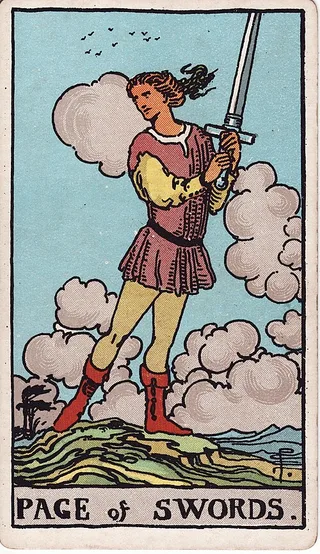
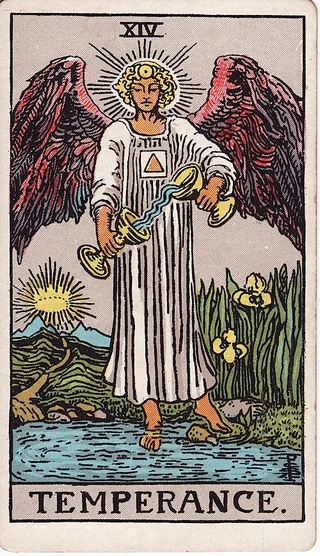
The following cards are selected by the editors for teaching. This is not a random draw, a real user's story or a transcript of an AI response. All three are upright. The images show the same fixed example in each language.
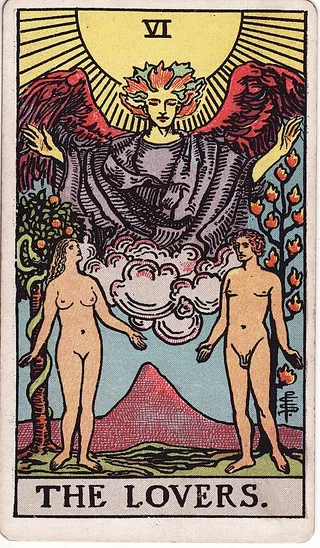
1. Past — The Lovers
Use the theme of values and connection to ask what you want from the invitation: a relaxed conversation, a date, or certainty about a relationship? The card cannot establish mutual attraction. A useful starting point is knowing your own intention.
2. Present — Page of Swords
Use curiosity and communication as the focus. Separate the messages you have actually exchanged from the story you are telling yourself about them. You may need one clear question, not a long attempt to decode every reply.
3. Possible development — Temperance
Use balance and pacing as advice for the invitation. Offer a specific plan with room for a different answer. This is an action you can take; it does not predict that the person will accept.
Read the pattern, then choose one action
The teaching sequence is: clarify your intention → communicate plainly → leave room for a comfortable pace. A practical action is one low-pressure invitation: “Would you like to get coffee on Saturday afternoon? No worries if that doesn't work.” The other person's reply provides information the cards cannot.
Follow-up 1: turn the reflection into a message
Keep the same three cards and positions. Help me write a short coffee invitation that is clear about the plan and easy to decline. Separate the card symbolism from what we actually know.
This keeps the conversation anchored to the existing spread. Add the wording you normally use so a draft sounds like you rather than a formal script.
Follow-up 2: plan for a no or no reply
Without drawing again, help me respond respectfully if they decline or don't reply. What is within my control, and what boundary should I keep?
A respectful next step may be accepting a refusal or giving space. Silence is not proof of a secret feeling. You do not need to keep drawing until you obtain reassurance.
What if a card is reversed?
Decide before the reading whether you use reversals. One consistent approach is to examine a blocked, excessive or inward expression of the same theme. For example, reversed Temperance could prompt a question about rushing or imbalance. It does not automatically turn the whole spread into a negative answer.
Common questions
Must I ask a question?
No. You can begin with an open reflection and add context afterward. A specific question often makes the suggested next step easier to evaluate.
Can three cards tell me exactly what someone feels?
No. Use the spread to examine your perspective and choices, then ask the person directly where appropriate. A symbolic reading cannot verify private intentions.
Can I ask another question without redrawing?
Yes: specify that you want to continue interpreting the same cards. Restate the names, positions and orientations if needed. A follow-up can clarify the first reading without turning every message into a new draw.
Try the existing Luna tarot entry
Open Luna's tarot conversation, choose three cards and add an optional question. Your own draw will differ from this fixed example. Check the product for sign-in requirements, available readings and prices.
For another beginner explanation of assigning positions before interpreting, see Labyrinthos's tarot spread guide. The coffee example and follow-up prompts above are original editorial material.
Read this guide in English · Español · Português do Brasil.
A recorded service example, separate from the teaching prompts
Read the actual cards and the same-card follow-up. It is an English editorial explanation of a Korean API execution from October 27, 2026, with original excerpts and explicit limits. It is not a new English test, customer testimonial, browser recording or proof of permanent memory. Evidence link added October 28, 2026; the original publication date and teaching examples are retained.